
Try a different angle
Einstein said it before: “*Insanity is doing the same thing over and over and expecting different results*.” Our Tryangle tagline “try a different angle” suggests that we listened carefully to Einstein and like to look at and tackle things in creative ways.
First of all, we bring the topics we work on to life in a unique way. Our style is based on learning-by-doing, movement and fun. In addition, we also focus on distinctive themes. We strongly believe that the increasingly prominent reports about all kinds of workplace challenges, including declining motivation and deteriorating (mental) well-being among employees, call for a different approach.
Happiness at work
So what exactly does this different approach involve? More attention and opportunities for greater well-being and happiness in the workplace!
The good news is that there are many benefits associated with a happiness at work strategy, and that organisations can use different themes and building blocks to increase their employees’ happiness at work – and the positive outcomes that come with it.
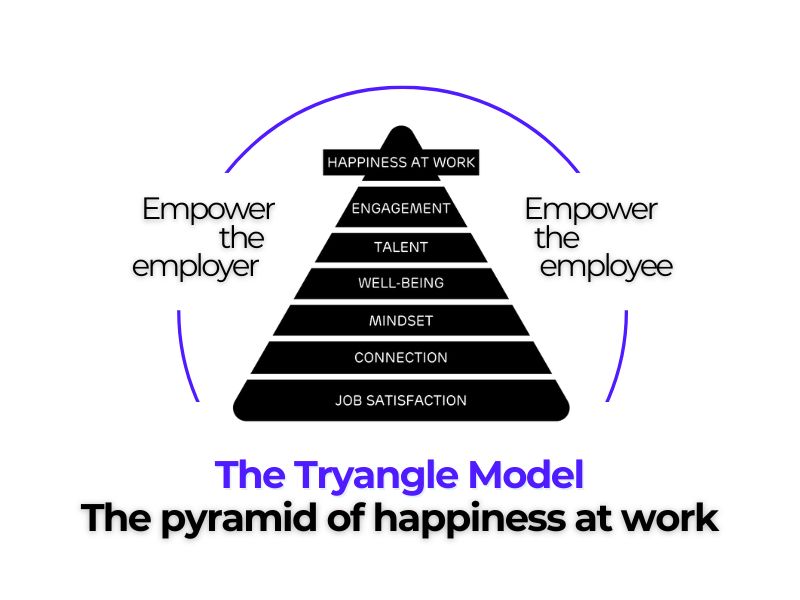
In this article, we explain our Tryangle happiness at work pyramid, which we use to help organisations create positive company cultures where happiness at work can thrive.
Why a pyramid?
Experience has taught us that working on happiness at work requires a phased approach. First of all, a stable foundation is needed in which job satisfaction and strong collaboration are possible. Once a solid foundation is in place, specific attention to themes such as a positive company culture and well-being at work can help employees increasingly play to their strengths. Focusing on employee engagement and talents can create maximum room for sustainable happiness at work. These phases are reflected in the 7 layers of the Tryangle pyramid model.
Happiness at work as a strategy
This pyramid model makes it clear that simply going for the cherry on top without a solid foundation is not a sustainable approach. When, for example, there are frustrations about pay or working conditions, difficult relationships with colleagues or managers, or high levels of stress and workload, it is not easy – perhaps even impossible – to progress towards happiness at work.
The model also helps illustrate that organisations can focus on several components that reinforce one another. Happiness at work is therefore not something you can simply achieve through one single intervention or a quick fix.
Which areas you prioritise, and exactly how you shape the activities within each theme, depends on several factors, such as specific needs and environmental factors, the organisation’s objectives and values, the company culture, managers, and more. Just as different personalities are motivated by different things and experience happiness at work differently, there is no one size fits all approach that works for every organisation. A carefully chosen strategic approach consisting of the right happiness at work drivers has the best chance of success.
Happiness at work as a shared responsibility
Happiness at work starts with individual employees, who can take plenty of action themselves. At the same time, it is also up to the CEO, management team, HR, prevention advisor, managers, and others to create the best possible environment in which employees can feel good and to guide and support them where needed.
This means that organisations can work on happiness at work themes in different ways. Bottom-up: you can encourage employees by providing tools, information and insights that enable them to work on well-being and happiness at work themselves (‘empower the employee’). Top down: as a management team, HR professional, prevention advisor or manager, you can decide which strategies, processes and knowledge are needed to create the best possible environment in which employees can perform at their best (‘empower the employer’).
Tryangle supports organisations, teams, managers and employees with tailored consulting, training, coaching, team building and more, across a wide range of workplace themes.
The following sections show what that support can look like for each theme.
Concrete steps towards greater happiness at work
In line with the 7 layers of the happiness at work pyramid, these are the areas organisations can focus on:
1. Check whether job satisfaction is on track
Build a solid foundation. When things go wrong at the basic level (working environment, pay, infrastructure, job descriptions, pre-boarding and onboarding, etc.), employees will inevitably develop negative feelings about their jobs. In short, without attention to the basic conditions and the *touchpoints* of the *employee journey*, every initiative around happiness at work will remain an isolated effort.
How can you address this as an organisation? Make clear agreements about all practical aspects that influence work, such as basic conditions, job content, the support provided, and so on. Take a critical look at the (hybrid) working environment as well: how can it be adapted so employees can feel as good as possible at work? By considering the different needs and preferences of various employee profiles and responding flexibly to them (think, for example, of generation management), you can also maximise basic job satisfaction.
Moreover, measuring is knowing. Does your organisation have recent figures that show how employees are doing in terms of well-being and happiness at work? Make sure those figures provide an accurate picture of reality and are more than boxes ticked on a checklist. Asking people for their input is always a good idea, provided you genuinely want to know the answers and are prepared to act on them constructively.
What can employees do themselves? Through self-awareness and self-leadership, employees can gain insight into the company environment, conditions and work-life blend that suit them and look for the best possible match. They can also take the initiative to raise challenges and areas for improvement and actively engage in job crafting within their current working conditions.
2. Invest in connection
A company stands or falls with a strong team and how well people work together. Creating the right climate for optimal teamwork in which people can collaborate efficiently as well as enjoyably – with attention to both results and relationships – is therefore essential.
How do you approach this top-down? Invest sufficient time and space in the elements that turn a group of employees into a genuine team: mutual trust, psychological safety, transparent and positive communication, a constructive feedback culture, and more. The impact of the manager is crucial here, because one of the key reasons people leave a company is their direct manager. People-focused, motivating leadership and a good balance between coaching and directive leadership are therefore increasingly high on employees’ wish lists, especially in a hybrid working reality.
From a bottom-up perspective, individual employees naturally also have a major role to play in creating positive workplace relationships. Strengthening communication and other interpersonal skills (for greater appreciation, empathy and connection) gives a positive working atmosphere and constructive collaboration every opportunity to thrive.
3. Create a positive company culture
An authentic and positive company culture with strong values that are fully embraced throughout every level of the organisation creates the foundation for employees to feel at their best and achieve strong results. Research in the field of positive psychology shows that a company culture rooted in positivity performs better than a power-driven environment based on pressure. Moreover, such a working environment leaves less room for toxic stress and negativity and more room for reframing problems as challenges and developing creative solutions.
For the organisation: Happiness at work is supported by the combination of how people think and how behaviour and responses are adjusted. Knowing that what you focus on grows, it makes sense to address the ‘negativity bias’ and create a culture in which more conscious attention is paid to what is going well. As an organisation, you can achieve this by acting and thinking from a growth mindset and fostering an open culture around mistakes, while also creating positive moments such as celebrating successes, random acts of kindness and paying attention to appreciation, diversity and inclusion.
For the employee: You can also encourage employees to take the initiative themselves by teaching them the principles of positive psychology and encouraging them to apply these in the workplace. There are, for example, many training programmes on strategies for dealing with workload, worrying, perfectionism, and more. Applying a growth mindset and focusing on positive thinking, mindfulness, mind fitness, energy and attention management, etc. can have a significant impact on how individual employees feel and perform, while also creating a spill-over effect that contributes to a positive cycle in team dynamics.
4. Focus on well-being at work
Stress and increased workload can lead to reduced productivity (presenteeism) and absenteeism (burnout and other conditions). Only by ensuring that everyone within an organisation can take an active and preventive approach to well-being and stress-related issues can organisations contain these growing challenges and costs.
Top down: A corporate well-being strategy combines all the information and tools a company can provide around vitality and healthy habits for body and mind. Supporting employees’ physical and mental well-being helps prevent stress and burnout while improving the overall resilience and performance of teams. The right knowledge and procedures enable management and managers to provide employees with the best possible support across all aspects of well-being: addressing psychosocial issues that can lead to short- and long-term absence, establishing constructive dialogue and an effective preventive approach to resilience, recognising signs of stress and burnout in time, and providing strong support during absence and reintegration.
Bottom up: Precisely because we spend so much time at work, it is important to encourage employees to cultivate healthy habits themselves for greater resilience, vitality and physical and mental well-being. By offering well-being interventions internally, organisations can teach employees techniques that can be applied both curatively and preventively. A supportive approach to well-being at work can include concrete information and tools on topics such as understanding unhealthy stress, healthy ways of dealing with stress and workload, ergonomics, exercise, nutrition and health.
5. Invest in talent management
Investing in talent management, identifying and developing existing talents, and placing employees in the right role within the right team leads to exceptionally strong results that are much harder to achieve when the focus is solely on competency development without underlying passion.
As an organisation: Opportunities to learn new things and continuously develop have become hot topics in the labour market. Organisations and managers who build on existing talents also create greater efficiency and better performance. Supporting and further developing an existing talent will always produce faster results than trying to build a competency for which someone has little natural aptitude.
For employees: Encouraging employees to discover where their strengths lie, how they can develop their talents, and to communicate openly about them is also an ideal way to increase energy, enjoyment at work and results.
6. Give employee engagement every opportunity to thrive
Engaged employees are the fuel of an organisation. Drive and involvement, combined with the space and autonomy to take initiative, grow and learn, create enjoyment at work, a sense of purpose and better performance. Companies that support and guide their employees in the right way are organisations people want to work for, and this forms the core of a strong retention strategy.
Top down: Creating sustainable happiness at work is about more than the traditional pat on the back. When employees are given the responsibility, autonomy and freedom they feel comfortable with to think for themselves and help shape both the content of their work and how it is carried out, within a clear framework and towards a clear goal, they will experience greater pride, motivation, engagement and enthusiasm.
Bottom-up: Employees also hold some of the keys to increasing their own engagement and performance when they understand their personal motivators, goals and passions and can actively look for a job or set of responsibilities that aligns with these, provides satisfaction and a sense of purpose, and enables them to perform at their best.
7. Happiness at work as a company mission
Companies with a clear happiness at work strategy that focus on several of the happiness at work dimensions above create a constructive environment in which employees feel good. In this positive employee experience, employees enjoy their work, can work together with others in a positive setting and have the opportunity to do meaningful and purposeful work. This creates a more productive environment while also building a strong employer brand that helps attract the right employees. These companies make the difference today and in the future. Or, as we at Tryangle have been saying and writing for some time: the future belongs to the happy!
For organisations: Just like an organisation’s mission, vision and values, happiness at work can be integrated and embedded into the company’s DNA. The key is to define what happiness at work means for your organisation, make appropriate choices and translate them into an integrated policy.
For employees: Even within the most constructive company culture, employees themselves have an important part of their own employee experience in their hands. Everyone is different. With the right information and support, individual employees and teams can formulate their personal definition of happiness at work, explore which areas still offer room for improvement and receive the tools they need to take action.
Want to learn more about how Tryangle can help your organisation with well-being and happiness at work? Discover our services or download our brochure for a convenient overview. Feel free to contact us with no obligation.
Looking for inspiration on the importance of corporate well-being and happiness at work?
Take a look at our (in-company) workshops specifically focused on this topic.
For everyone: Well-being at work: Myth or reality? A sustainable corporate well-being approach encompasses all the information and tools a company can provide around vitality and healthy habits for body and mind. In this session, we take a closer look at the importance of well-being interventions and encourage management, managers and employees to reflect on their impact on well-being in the workplace, while participants discover plenty of do’s and don’ts.
For managers: Creating a positive employee experience for your employees Today, offering employees a good salary and good working conditions is no longer enough to retain them and attract top talent. The Employee Experience (EX) plays an increasingly important role. In this training course, you will work concretely with all the key moments in your organisation’s employee journey, from recruitment to exit, and discover opportunities to start conversations about these moments with your employees.
For managers and HR professionals: How to achieve the SDGs by investing in people The UN Sustainable Development Goals are becoming increasingly important in the business world. What exactly are these SDGs, and which ones matter when it comes to a people-centred approach? In this session, we formulate practical ways to give the SDGs a place within your organisation, with a focus on sustainable careers, diversity and inclusion, and striving for healthy people in a healthy workplace.